
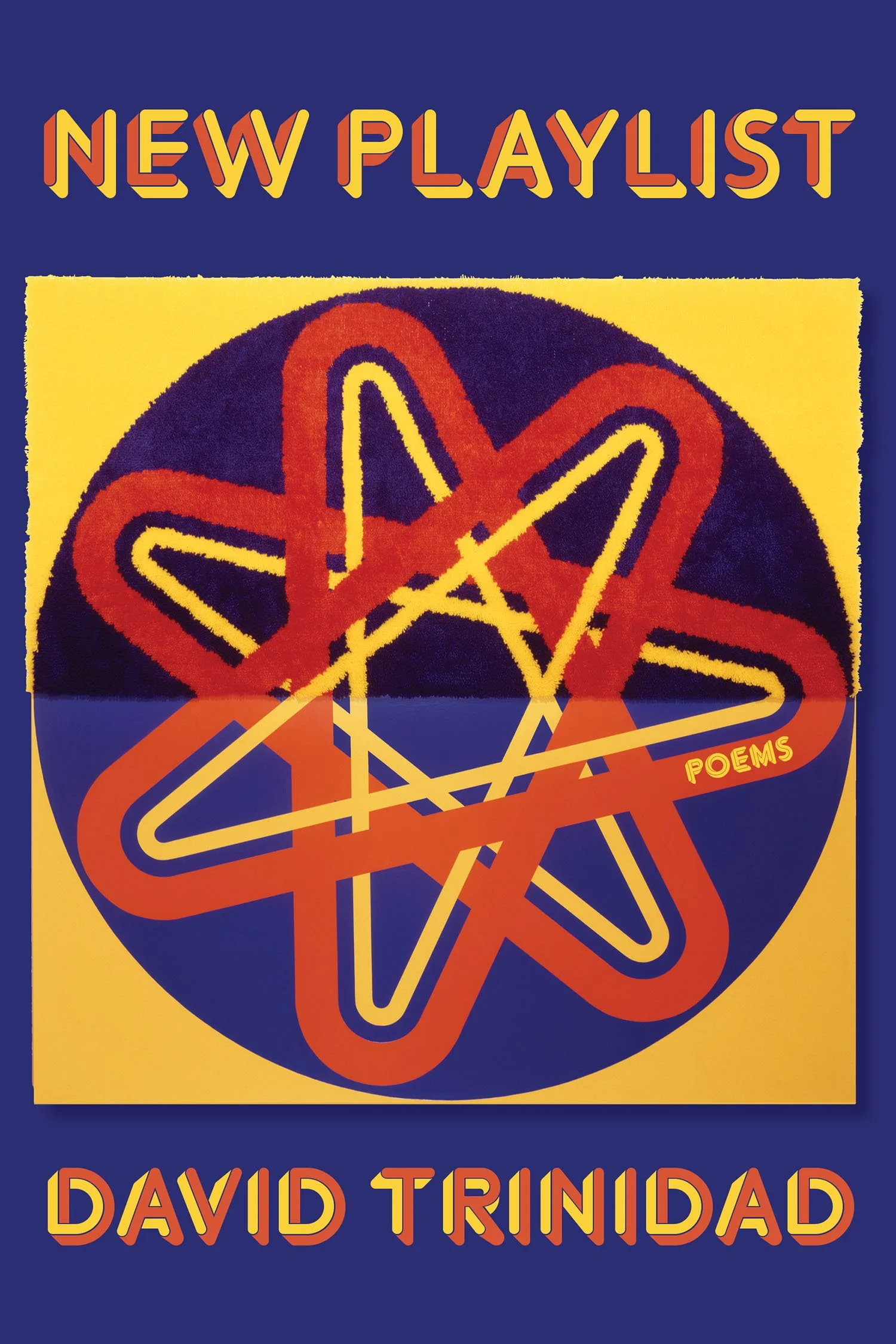
I recently received two books in the mail from poet David Trinidad—Hollywood Cemetery (Green Linden Press, 2025) and New Playlist (University of Pittsburgh Press, 2025). “Greetings from Hollywood,” one inscription read. Both books came with a surprise inside: David had mailed along collector’s cards from the 1930’s featuring two actresses found in his poems, the sort of toy cards which I imagined would have come in a Cracker-Jack box, mint condition. That is the delight of Trinidad’s poetry. It is an archive of saved things (surprises?) which, from the early 1980’s, have amassed into a museum of work like no other poet—stanzas, lines, titles, facts, dates, revelations, all mint condition.
New Playlist—Find this book, buy two copies, gift the second to a dear friend, play on repeat.
(Interview conducted May 2025)
rex inc.: How did New Playlist come together?
David Trinidad: I had just been writing poems for a few years, putting them in a file without much thought of an eventual manuscript. And publishing some of them in journals when solicited. At some point, I took a look at the file and found, to my surprise, that I had enough for a book. I’m usually more intentional than that, in terms of manuscripts in progress. I pretty much kept the poems in the order they had been written. The manuscript as a whole had a relaxed feel, and a sense of playfulness, in subject matter and form, so that’s what led to the title.
ri: What relationship does the book have to your other collections of poetry? (Hollywood Cemetery debuted this year as well.)
DT: Most of the books I’ve done in recent years have been theme-based, like Hollywood Cemetery, which is a Spoon River-esque choir of voices—in this case, dead Hollywood actors. Sleeping with Bashō is a faux translation of all of Bashō’s haiku. Notes on a Past Life is a memoir in verse, about the years I lived in New York. I suppose you could say that the poems in New Playlist have a central theme, but if so it wasn’t a conscious decision. They’re strictly the poems I wrote over a specific period of time. I guess it’s inevitable that my interests and obsessions would shape the poems, and possibly give them a sense of unity.
ri: There seems to be a motif of the missing—an actress or poet who died too young, missing scenes cut from movies, a beloved style of pen from childhood which can’t be found, a lost Bashō haiku about the moon, of remembrance of things gone by, a missing prom dress, “Stolen Jewels”—how do you see this coming together in the book?
DT: I think you do a pretty good job of it yourself! Now that you mention it, I can see how that’s one of the prevailing concerns. I’ve always been fascinated by lost things. Haunted by some of them, actually. Being a collector, and a completist, I’m saddened when you can’t see or have or read everything. Sylvia Plath’s missing journals, for instance. Or the substantial correspondence between Anne Sexton and James Wright. His copy was lost in a fire, and hers disappeared after her death. Sappho’s poems, and so much of ancient literature. So many silent and early sound movies, lost due to neglect. I know there are no guarantees, but still. I’ve been doing a deep dive into Charles Olson, and just this morning read that two of his poems, mentioned in letters to Robert Creeley, were lost due to water damage. Instant pang of regret. I want access to it all.
ri: You’ve been publishing books of poetry for more than four decades—what have you learned, and what advice would you give to your younger self?
DT: I’m sometimes amazed that I’ve been able to write and publish as many books as I have. And to have been able to live, for all intents and purposes, a literary life. What would I say to my younger self? I don’t know. Have faith. Don’t get too hurt or disappointed. Something you want this bad can’t help but come to pass.