
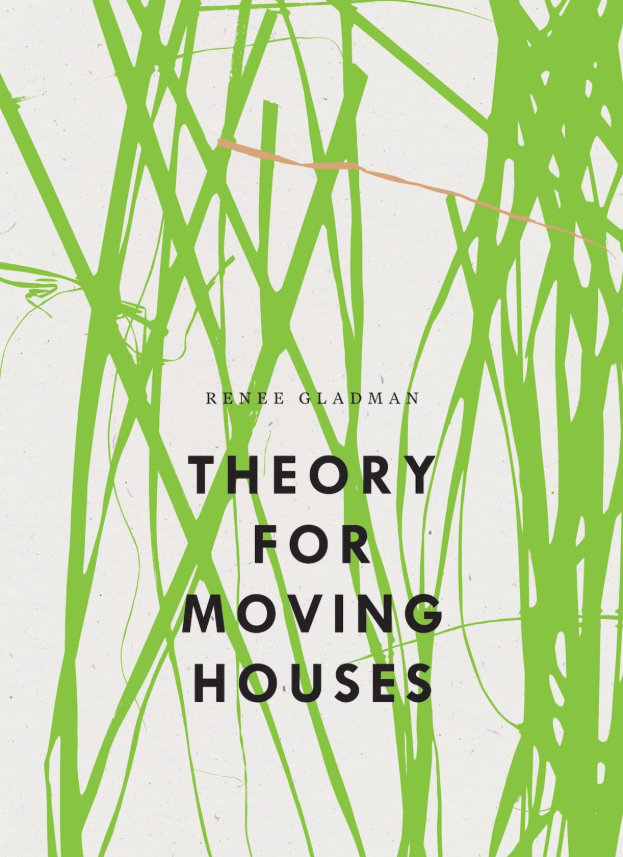
Renee Gladman // Wave Books, 2026
Theory for Moving Houses // Wave Books, May 2026
Circuitous then straight-forward, one-time self-contradicting, this book is a little Beckett, a little Gertrude Stein. It’s a sort of self-reflective manual for how to consciously write fiction. It’s a sort of autodidactic science for how the body writes. It is an exploration of the underlining storytelling of Gladman’s Ravicka novels. It “is a book of lectures about living in and as invisible structures; it’s about fictional knowing, and about gestures that electrify our spaces of wander—where we breathe and where we glow, where we think and what we produce from out thinking” (pg. 35).
I want to call this book a collection of essays, but perhaps they are prose poems, or something between these two spaces. The book has two parts—the first is described above as a manual for writing (and understanding) the project of Gladman’s fictional work. The second part—These are the Grasses of Ravicka—is an enactment of the principles of this theory, a continuation of the Ravicka novels. Gladman describes this part of the book as drawing in language.
This is an interesting book. For me, it teaches something about how language can enact a belief in the world, it can make the rules of its own storytelling. Gladman is a master writer, writing out the belief of how creativity operates in her mind and through her body. It is a guide to any creative person trying to capture how the body makes the thing.
This book also teaching me something about how to tell stories which are true to the characters, through their phycology, and how language necessitates a referential domain. As writers, we can choose to understand this, and write into that space, as Gladman always does.
Theory for Moving Houses—Read this book if you want to think about thinking.